
Saving mmdc.nl to the Wayback Machine
Latest update: 23-04-2026
About
mmdc.nl - the Medieval Manuscripts in Dutch Collections website of the KB, national library of the Netherlands - has been phased out on 15 December 2025.
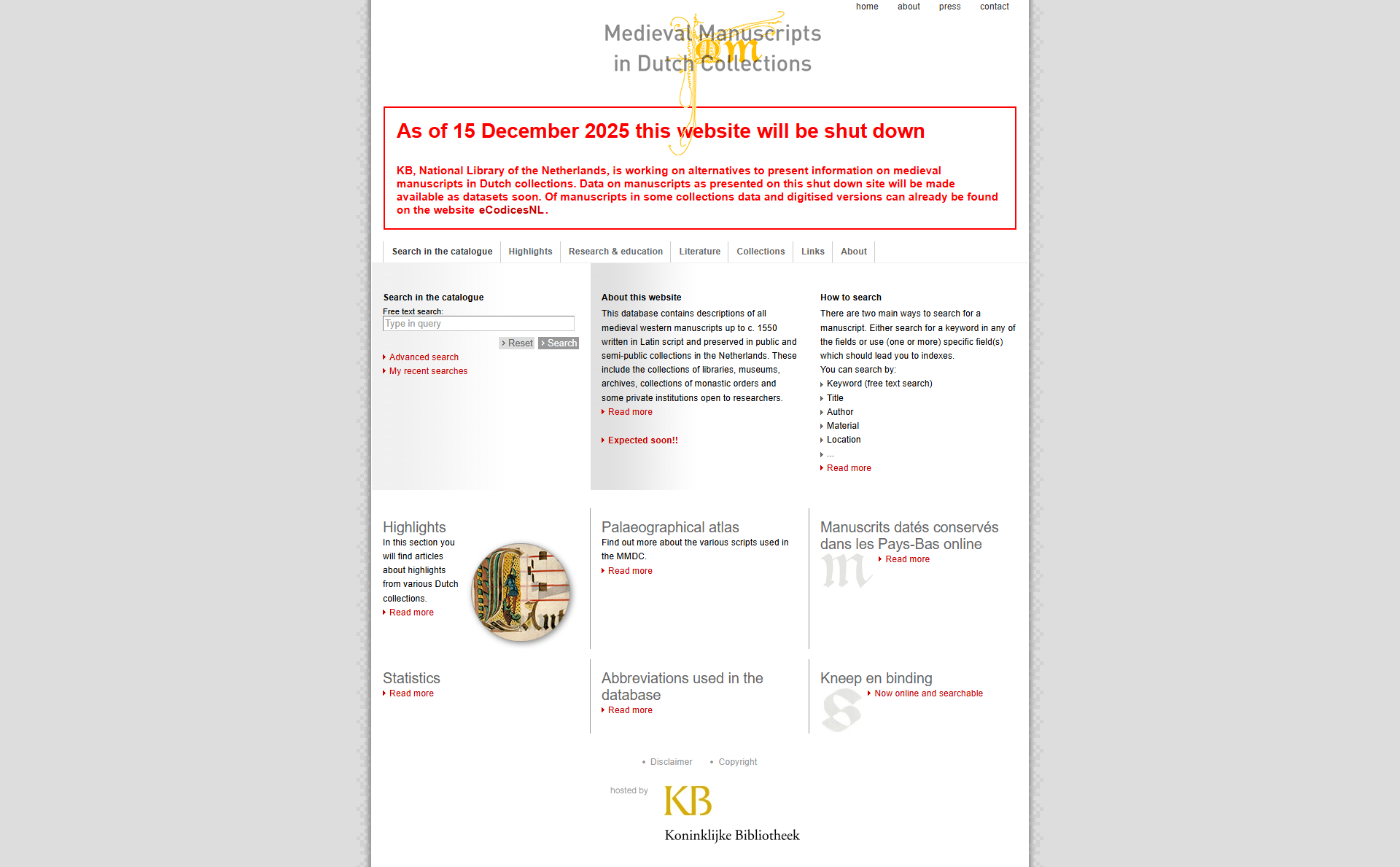
Before the site went offline, its URLs were archived to The Wayback Machine (WBM) of The Internet Archive in two phases:
- First, its static pages, PDFs and images were archived during December 2025.
- In a second phase, the 11.738 manuscript catalog records were archived during April 2026, once their pre-rendered HTML form was ready (see below).
Results & URL spreadsheet
-
mmdc-urls-unified_15042026.xlsx is the master spreadsheet and the single source of truth for everything archived from mmdc.nl. It gives a detailed overview of all mmdc.nl URLs captured in the WBM. These include per-URL status, WBM capture URLs and timestamps, and local file paths for every individual item.
-
The Excel detail page gives the full column-by-column breakdown of all three sheets in the Excel:
non-catalog-pages(466 rows - Phase 1, Dec 2025)catalog-pages(11.738 rows - Phase 2, April 2026)catalog-pages-full-metadata(18.724 rows)
Screenshots
1. Static pages - before/after screenshots
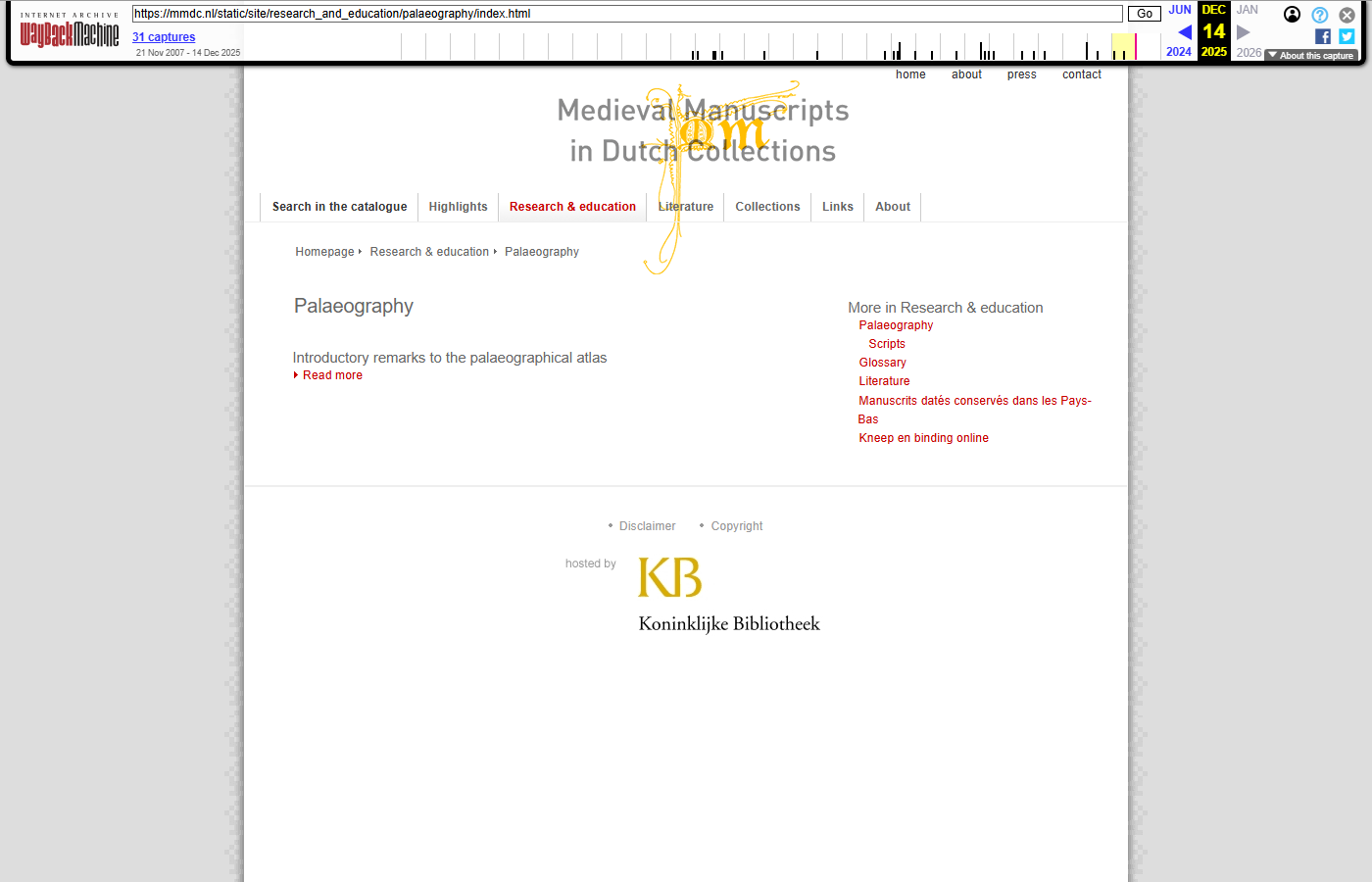
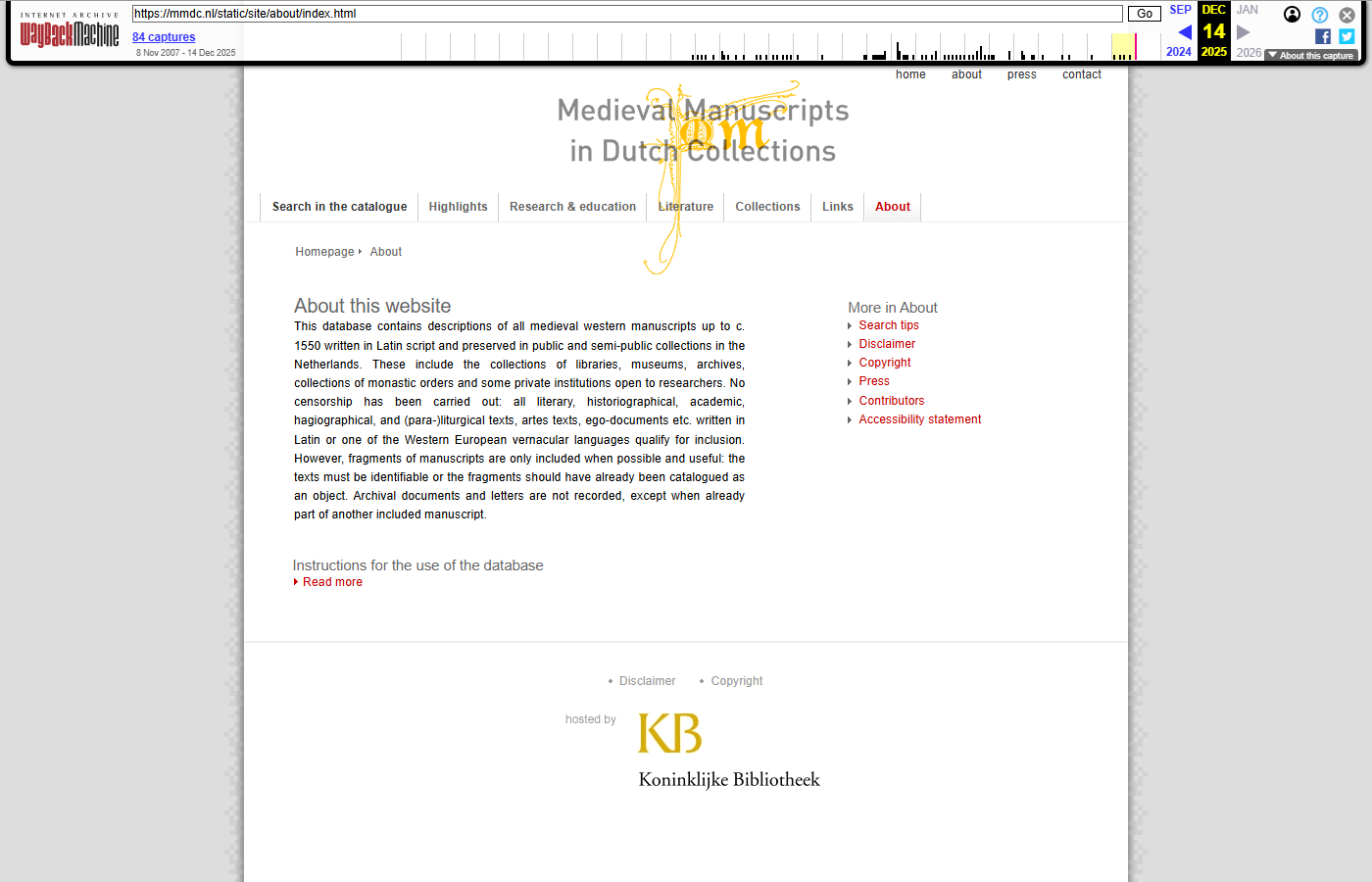
Each pair shows the (now defunct) mmdc.nl page (left) and the same URL as captured in the Wayback Machine (right, with the WBM toolbar visible at the top).
Homepage
| Original (defunct) | Wayback Machine |
|---|---|
| 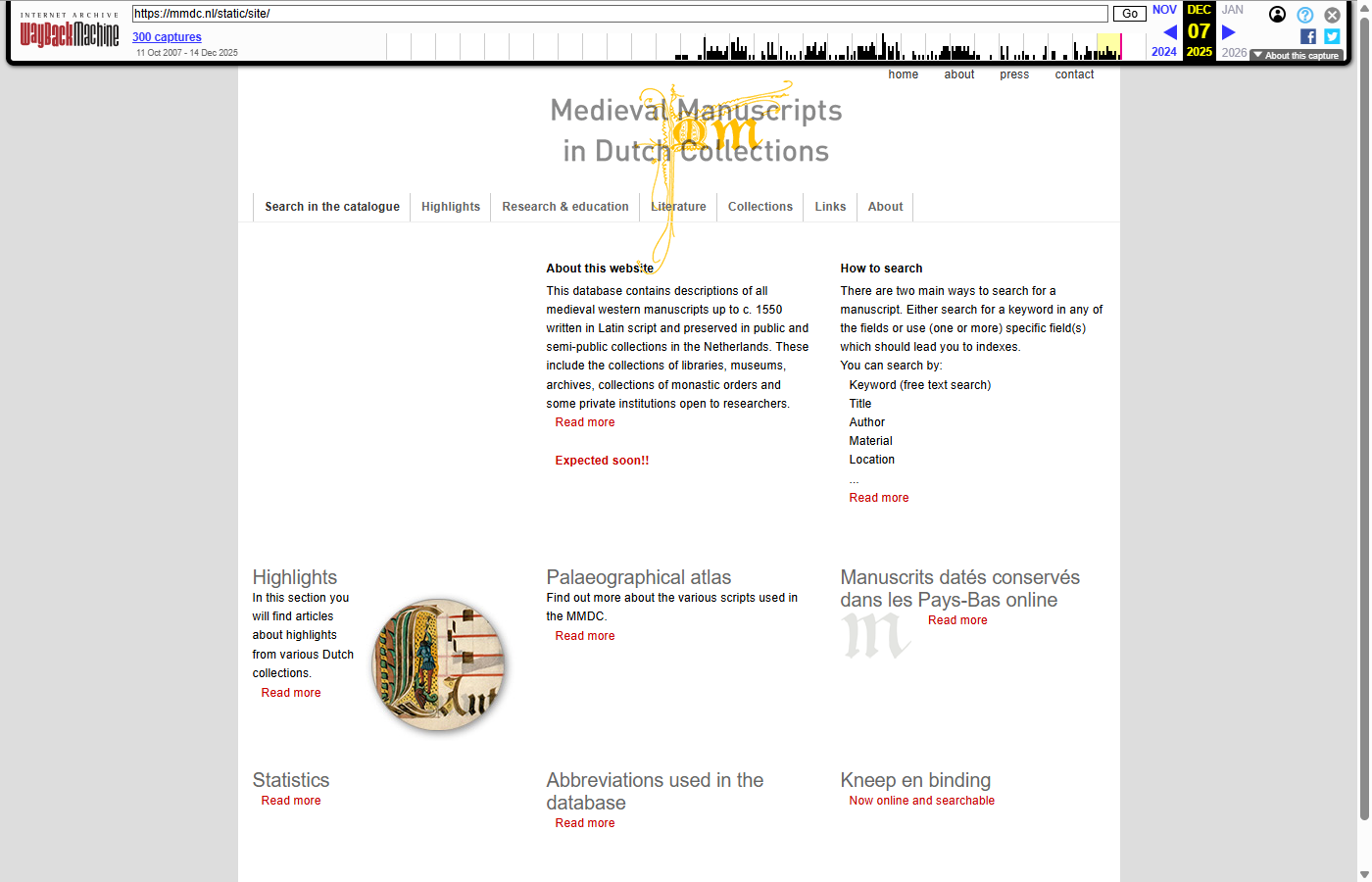 |
- Original: https://mmdc.nl/static/site/
- Wayback Machine (07-12-2025): https://web.archive.org/web/20251207222812/https://mmdc.nl/static/site/
Collections
| Original (defunct) | Wayback Machine |
|---|---|
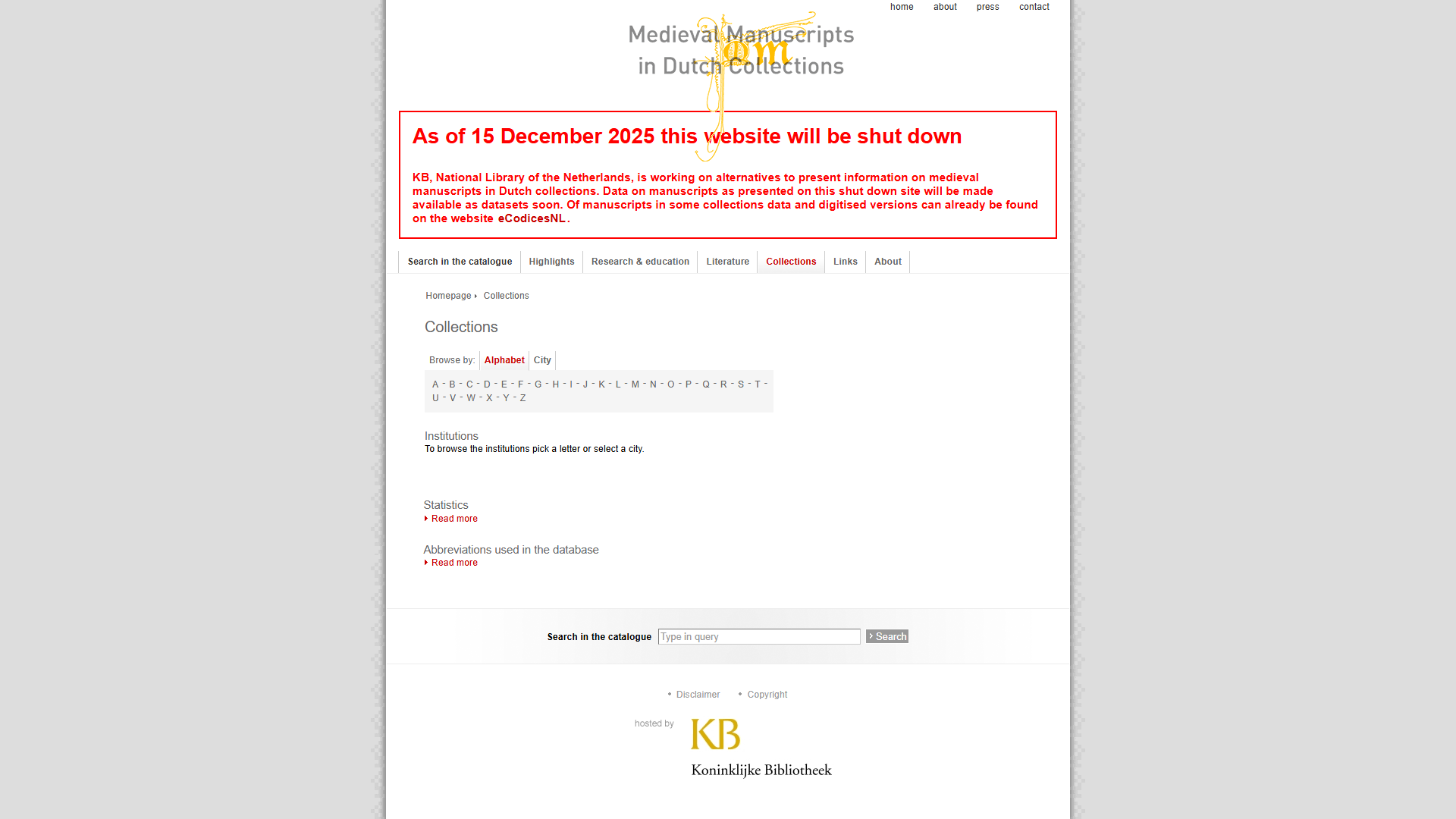 | 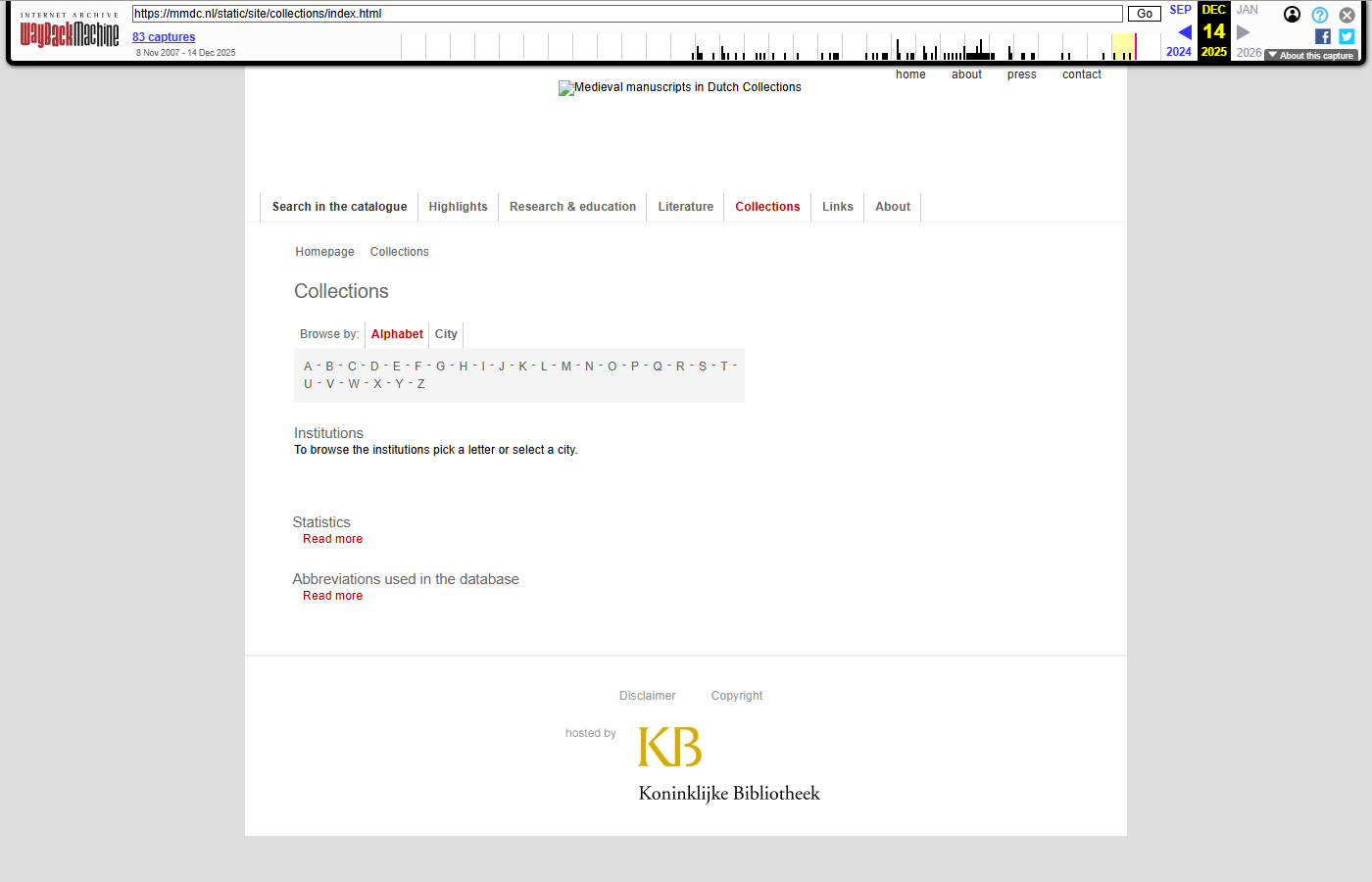 |
- Original: https://mmdc.nl/static/site/collections/index.html
- Wayback Machine (14-12-2025): https://web.archive.org/web/20251214072708/https://mmdc.nl/static/site/collections/index.html
Highlights
| Original (defunct) | Wayback Machine |
|---|---|
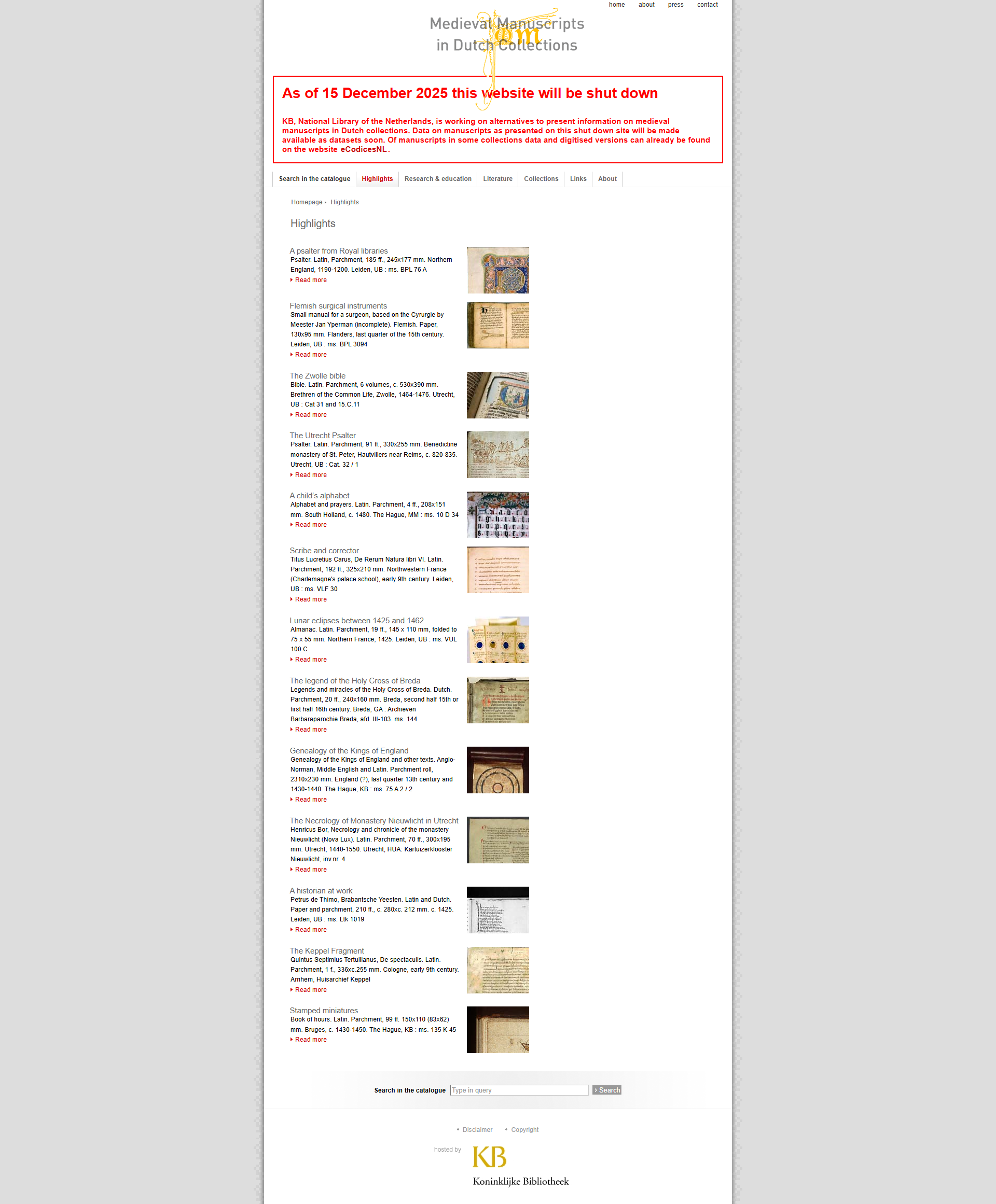 | 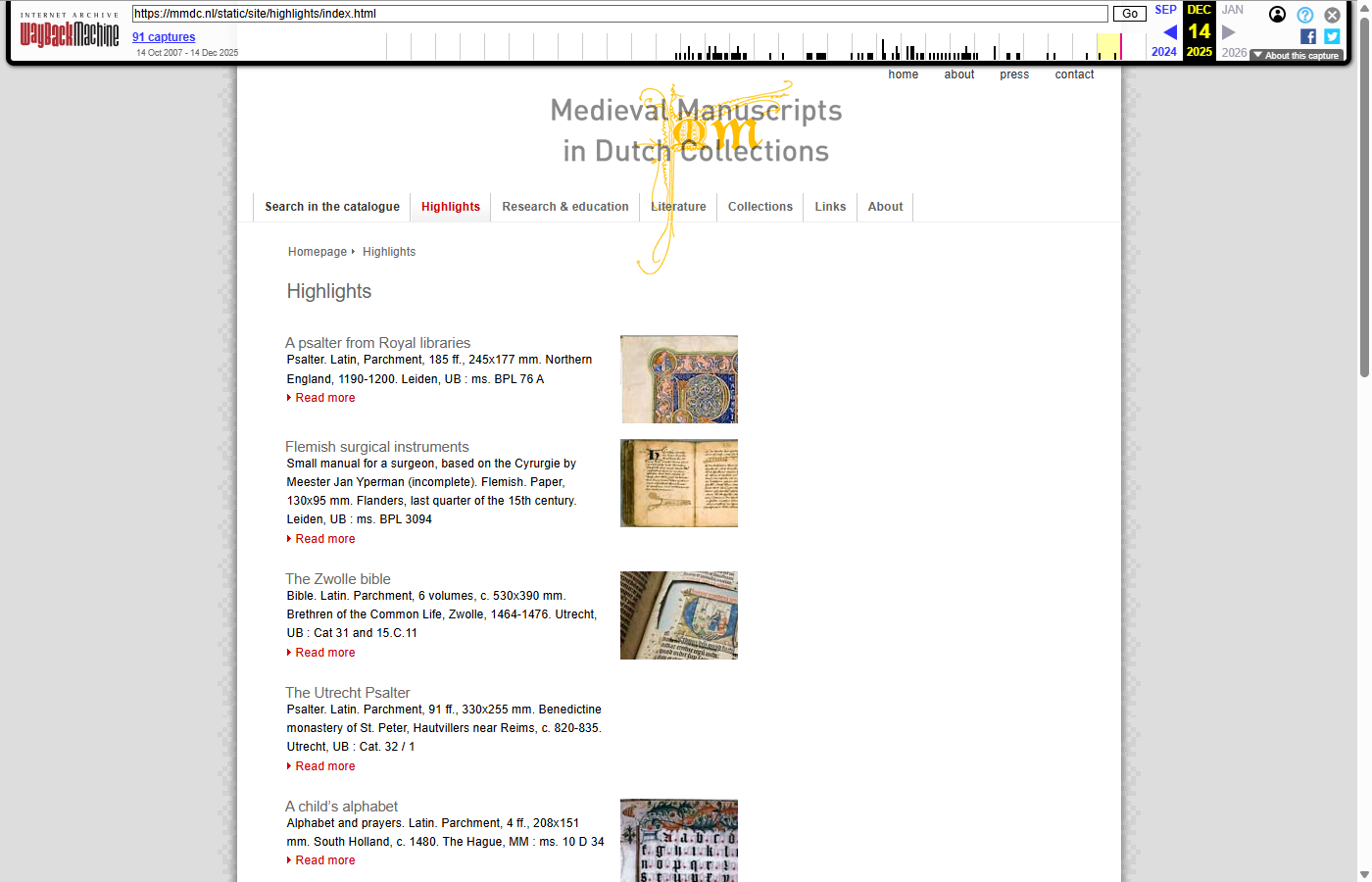 |
- Original: https://mmdc.nl/static/site/highlights/index.html
- Wayback Machine (14-12-2025): https://web.archive.org/web/20251214074859/https://mmdc.nl/static/site/highlights/index.html
Literature
| Original (defunct) | Wayback Machine |
|---|---|
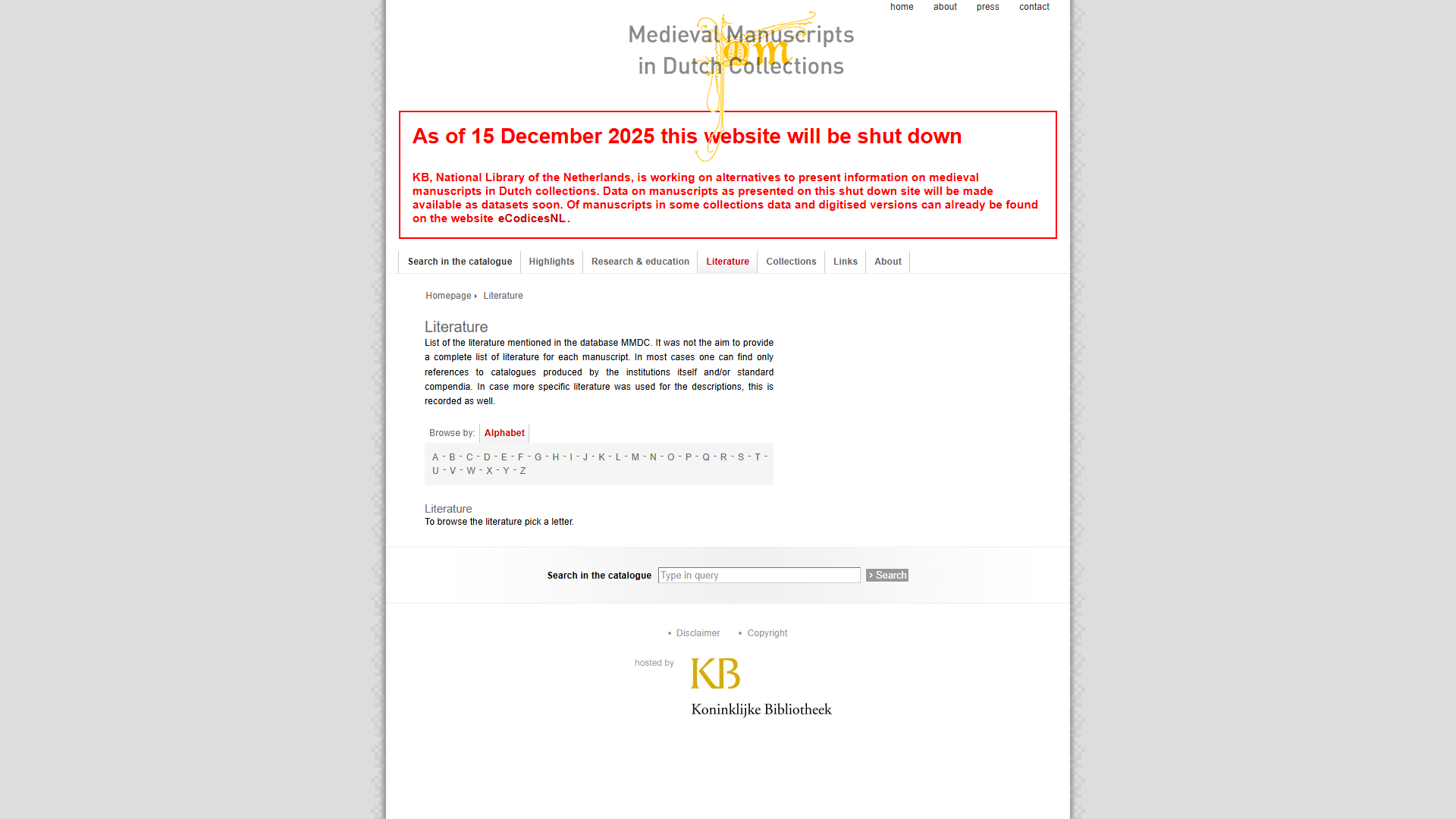 | 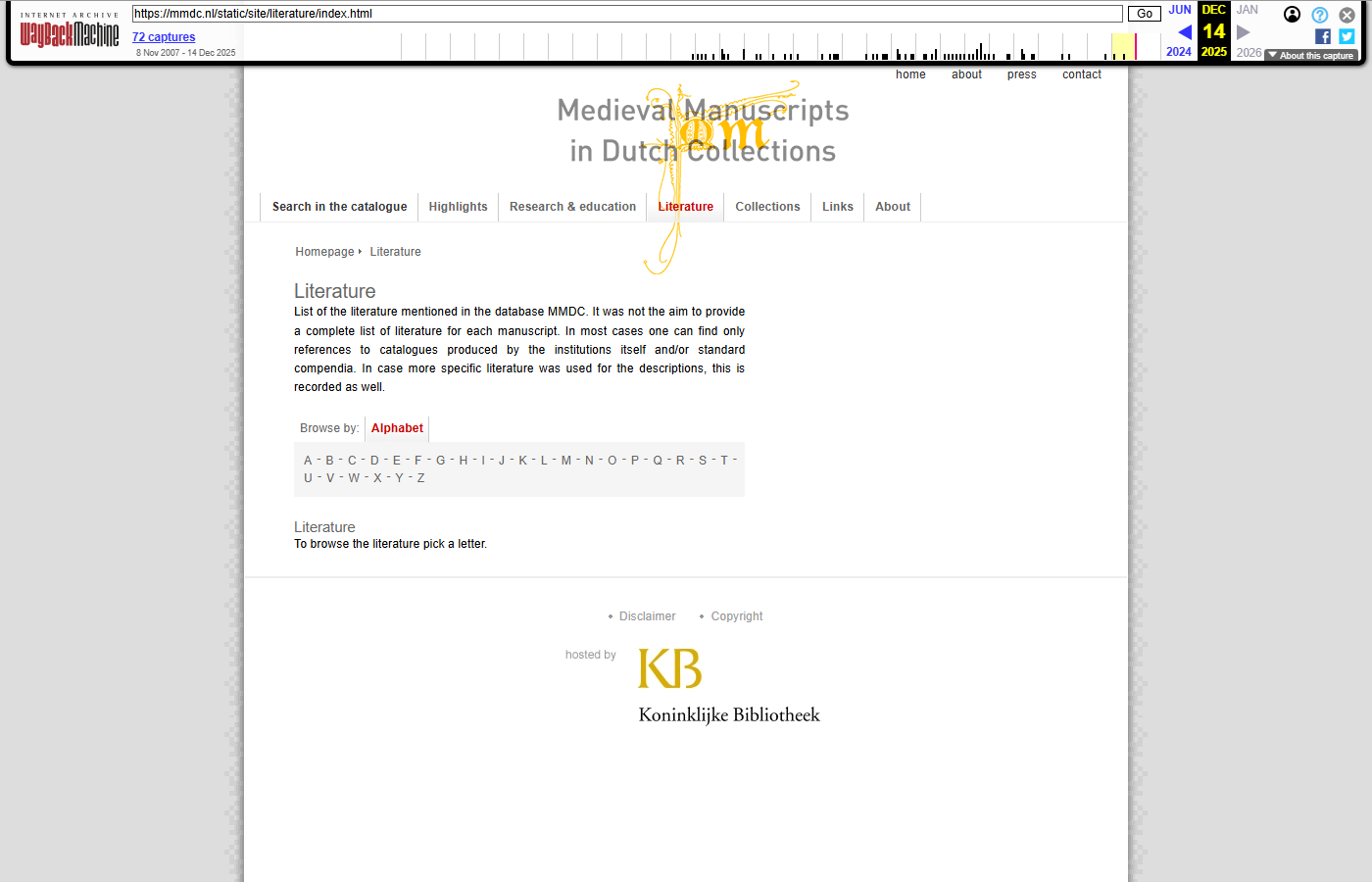 |
- Original: https://mmdc.nl/static/site/literature/index.html
- Wayback Machine (14-12-2025): https://web.archive.org/web/20251214080033/https://mmdc.nl/static/site/literature/index.html
Research & Education (Palaeography)
| Original (defunct) | Wayback Machine |
|---|---|
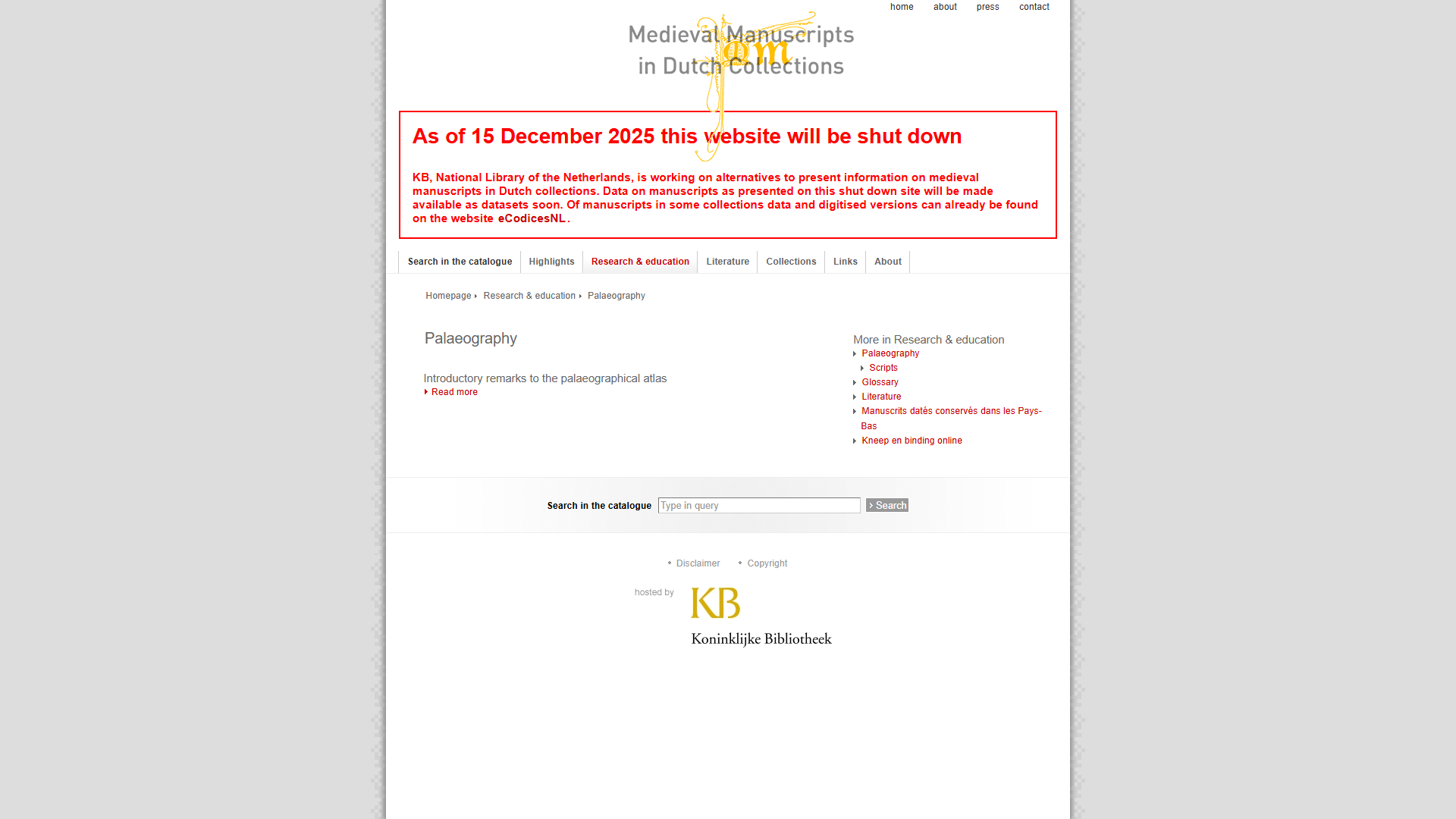 |  |
- Original: https://mmdc.nl/static/site/research_and_education/palaeography/index.html
- Wayback Machine (14-12-2025): https://web.archive.org/web/20251214082705/https://mmdc.nl/static/site/research_and_education/palaeography/index.html
About
| Original (defunct) | Wayback Machine |
|---|---|
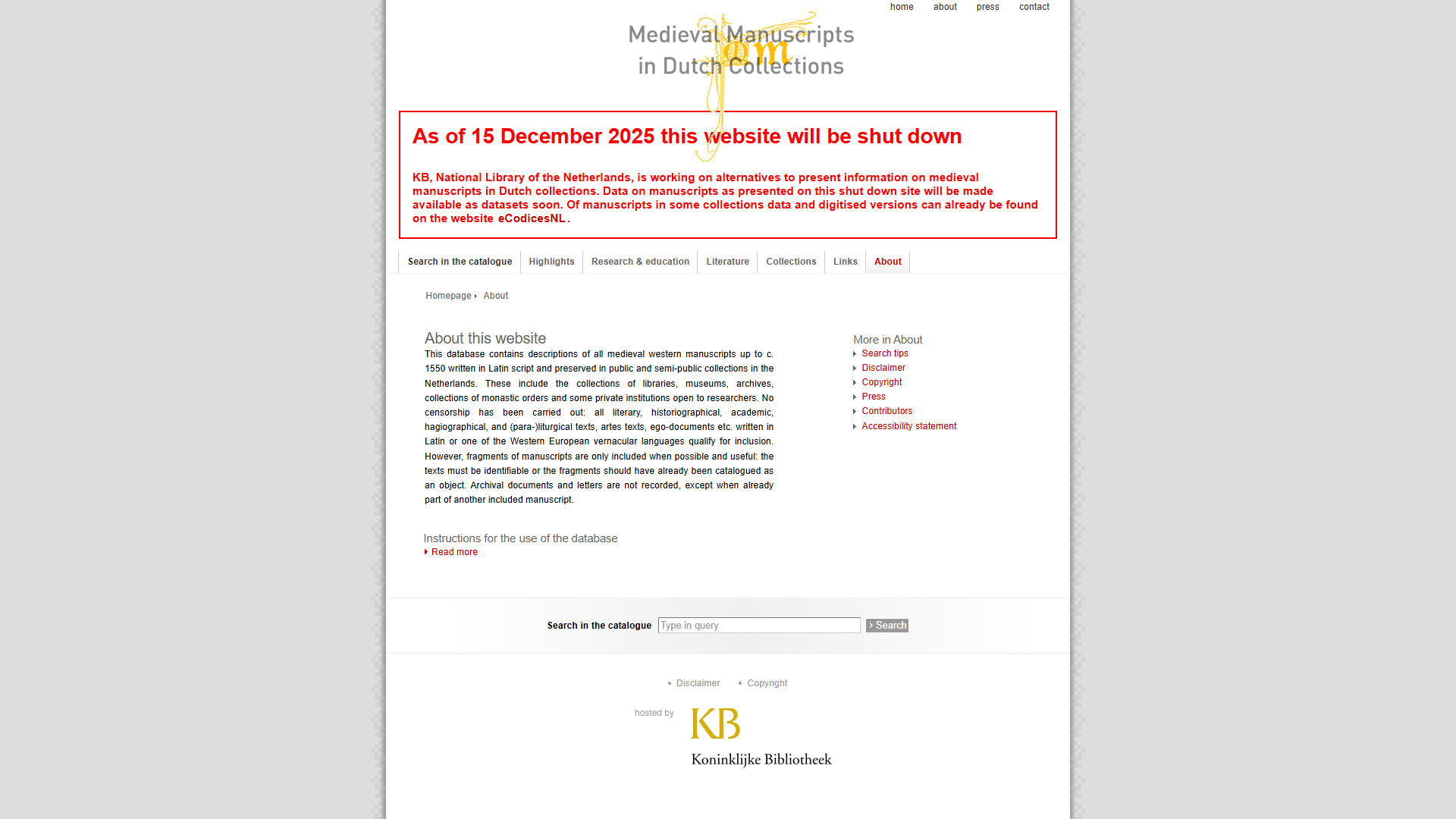 |  |
- Original: https://mmdc.nl/static/site/about/index.html
- Wayback Machine (14-12-2025): https://web.archive.org/web/20251214063529/https://mmdc.nl/static/site/about/index.html
2. Catalog pages
The 11.738 catalog (manuscript detail) records were JavaScript-rendered on the live site, so they were pre-rendered to static HTML and submitted to the Wayback Machine under the /wbm/site/search/catalog-page-N.html path. No comparable “before” WBM screenshot could be captured, because the JavaScript-based catalog pages were not suitable to be captured by the WBM - only the archived version of the pre-rendered HTML is shown below.
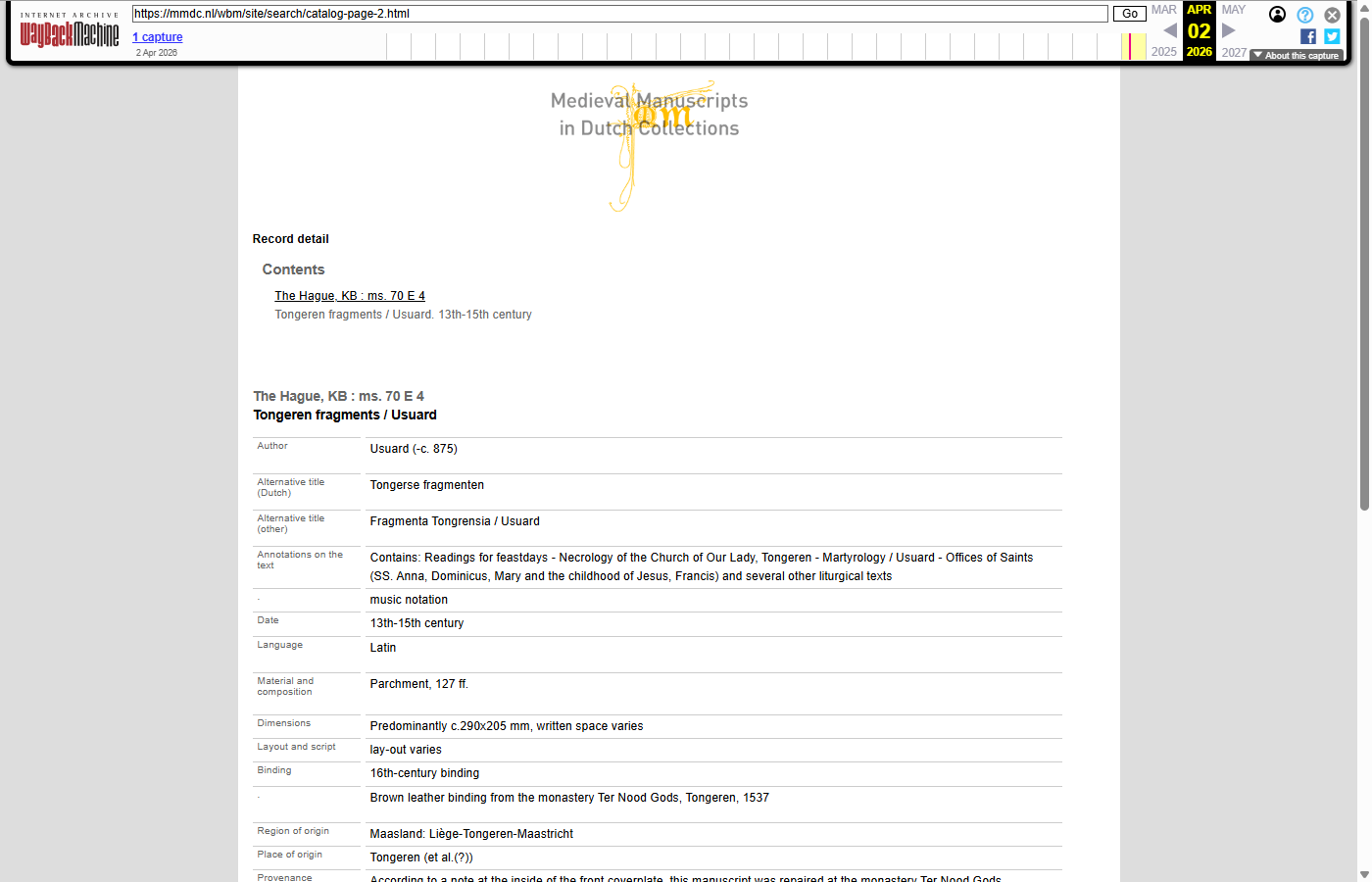 |
catalog-page-2: Tongeren fragments / Usuard - The Hague, KB : ms. 70 E 4
|
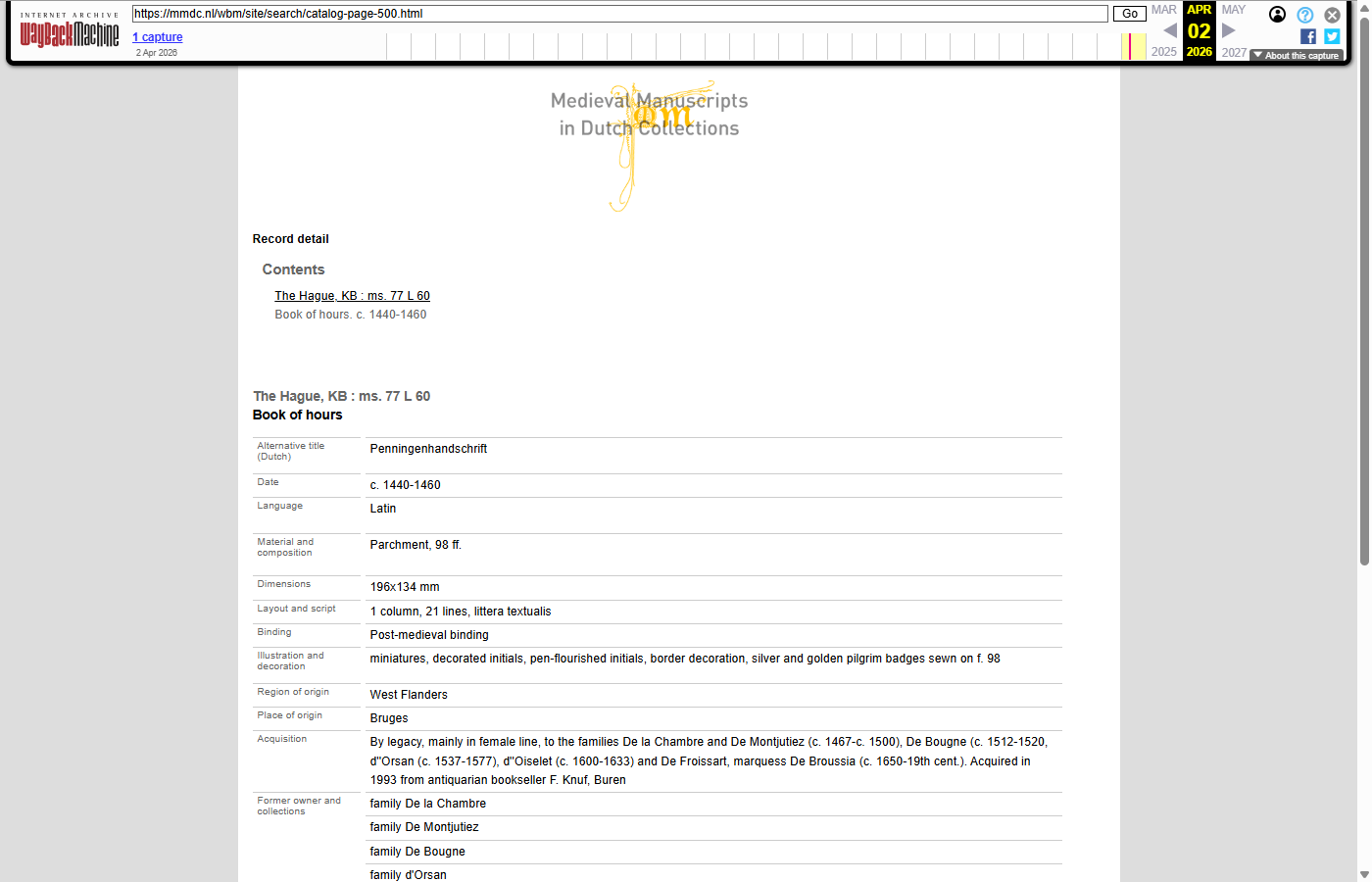 |
catalog-page-500: Book of hours - The Hague, KB : ms. 77 L 60
|
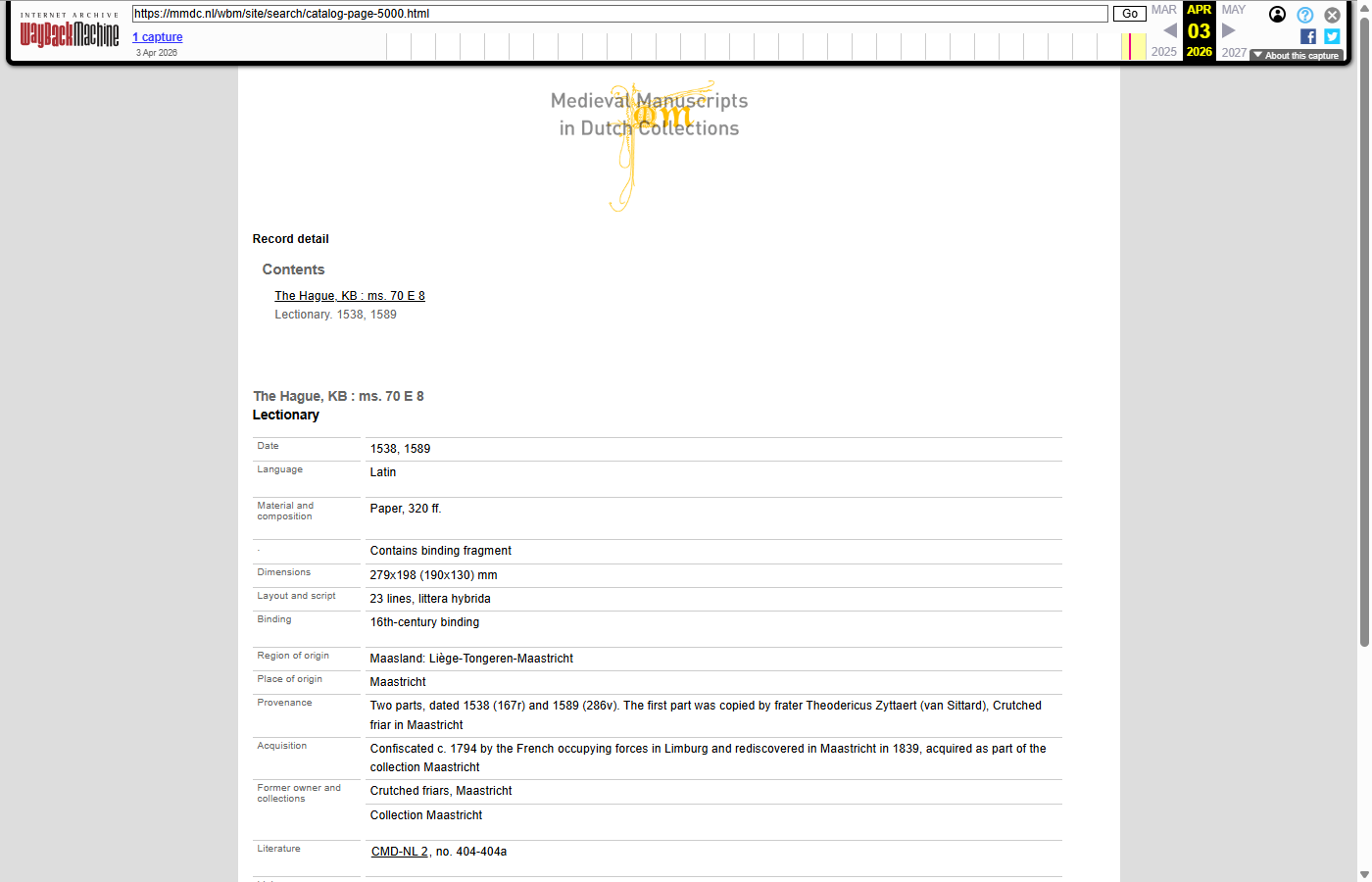 |
catalog-page-5000: Lectionary - The Hague, KB : ms. 70 E 8
|
How mmdc.nl got into the Wayback Machine
1. Spidering the site
Because mmdc.nl is a JavaScript-rendered single-page application, a simple HTTP crawler could not discover all URLs. A custom spider was built, see the _spider-artifacts/ folder:
-
Seed URLs - a manually composed list of top-level section pages (homepage,
/collections/,/highlights/,/literature/,/research_and_education/,/about/,/links/). -
Crawler - Python + Crawlee with a headless browser, renders each page, extracts internal links, and classifies them by URL pattern (
SEARCH_CATALOG,HIGHLIGHTS,LITERATURE,COLLECTIONS,STATIC_ASSETS, …) via url_classifier.py. -
Catalog expansion - search results were paginated and catalog IDs extracted using extract_catalog_ids.py and generate_catalog_urls.py to enumerate all 11.738 manuscript catalog records. PDF links were harvested separately using extract_pdfs.py.
-
Consolidation - all discovered URLs were deduplicated and written to a single spreadsheet using combine_all_urls.py and create_unified_excel.py, eventually resulting into the ‘master’ Excel mmdc-urls-unified_15042026.xlsx.
Full planning notes are available in PLAN-url-spider-mmdc.md.
2. Rendering the catalog pages
On the (by now defunct) live mmdc.nl site, every manuscript record lived behind a single URL of the form https://mmdc.nl/static/site/search/detail.html?recordId={N}#r{N}. The HTML at that URL contained almost no content: an empty <div id="recordDetail"> shell plus a block of JavaScript that fetched the record data client-side and injected it into the DOM. As a result, a conventional crawler — and the Wayback Machine’s Save Page Now robot — captured only the empty shell, not the manuscript description.
To work around this, a headless-browser rendering pipeline was built using Python and Playwright, implemented in render_catalog_full.py:
-
Load each record in a real browser. For every
recordIdin the unified URL list, Playwright opened the live page withwait_until="networkidle"and then explicitly waited for#recordDetailto become non-empty (up to 30 s), so that the client-side JavaScript had fully populated the record. -
Inline all CSS. External stylesheets were walked via
document.styleSheets, their rules serialised, and fetched<link rel="stylesheet">files downloaded over HTTP and concatenated. The resulting CSS was embedded in a single<style>block in the rendered file, so each page is a self-contained standalone HTML file with no external dependencies. -
Write a stable, flat filename. Each page was saved as
catalog-page-{N}.htmlunder_archiving-artifacts/local-archive/catalog-pages/, replacing the query-string URL (/static/site/search/detail.html?recordId=N) with a clean path-based one (/wbm/site/search/catalog-page-N.html) that the Wayback Machine could index cleanly. -
Resume, retry, log. The pipeline checkpoints progress to a JSON file, retries transient failures up to three times, and logs any unrecoverable errors to another JSON file. This means the full 11.738-page run could be executed over several sessions without data loss.
The 11.738 rendered HTML files were then put on a temporary KB hosted webserver at https://mmdc.nl/wbm/site/search/catalog-page-{N}.html and submitted to the Wayback Machine in April 2026. This is why the catalog pages in the WBM captures above show the full record content instead of an empty shell.
3. Submitting to the Wayback Machine
Once the full URL list was known, the URLs were submitted to the Wayback Machine using the Internet Archive’s Save Page Now 2 (SPN2) API with authenticated access.
The submissions were done in two phases:
-
Phase 1 — Non-catalog pages (Dec 2025): 466 non-catalog URLs (317 static HTML pages, 112 PDFs and 38 images) were submitted on Dec 7-8, 2025 using SaveToWBM_mmdc_non-catalog-pages.py. Result: 466/466 (100%) successfully archived.
-
Phase 2 — Catalog pages (Apr 2026): All 11.738 pre-rendered catalog pages were submitted Apr 2-11, 2026 using SaveToWBM_mmdc_catalog-pages.py. After an initial pass (11.658 successful) and a retry of the remaining 80, result: 11.738/11.738 (100%) indexed in the Wayback Machine.
Both scripts use concurrent connections (max 12), automatic retry on failure (up to 3 attempts), rate-limit handling, and checkpoint-based resume.
4. Local archive (on Github)
The rendered catalog pages are kept locally under _archiving-artifacts/local-archive/catalog-pages/ as a second, independent preservation copy. Because of GitHub storage limits, only 10 (out of 11.738) sample pages have been uploaded to this folder (catalog-page-2, 10, 100, 500, 1000, 2005, 3001, 5000, 7000, 9000).
The full set of 11.738 html files can be obtained from the Wayback Machine (using the master Excel), or via the KB (olaf.janssen@kb.nl).
Additionally, all static pages were rendered locally using render_static_pages.py. These, together with all PDFs and images, have also been archived locally on GitHub:
static-pages(318)pdfs(63)images(38)
5. Lessons learned
For a detailed account of what went wrong, what we tried, and what we learned — including the JavaScript rendering problem, the rate limiting disaster, and reflections on human-AI collaboration — see the Lessons learned page.
Folder structure
mmdc.nl/
├── index.md                              # This page
├── lessons-learned.md                    # Lessons learned from this project
├── excel-details.md                      # Column-by-column breakdown of the Excel
├── mmdc-urls-unified_15042026.xlsx       # Master URL list with WBM status
├── images/                               # Screenshots used in docs
├── _spider-artifacts/                    # URL discovery (the spidering run)
│   ├── input/seed-urls.txt
│   ├── scripts/                          # spider.py, url_classifier.py, …
│   ├── docs/                             # PLAN-url-spider-mmdc.md, DISCOVERY-sru-api.md
│   └── runtime/                          # checkpoints, logs, storage
└── _archiving-artifacts/                 # WBM submission & local rendering
    ├── scripts/                          # 4 core Python scripts:
    │   ├── render_static_pages.py        #   render static pages to standalone HTML
    │   ├── render_catalog_full.py        #   render all 11.738 catalog pages to standalone HTML
    │   ├── SaveToWBM_mmdc_non-catalog-pages.py  # submit static pages to WBM
    │   └── SaveToWBM_mmdc_catalog-pages.py      # submit catalog pages to WBM
    ├── data/                             # JSON result files (progress, results)
    └── local-archive/                    # Full local site copy
        ├── static-pages/                 #   318 rendered static HTML pages
        ├── catalog-pages/                #   10 sample catalog pages (of 11.738)
        ├── pdfs/                         #   63 PDFs
        └── images/                       #   38 images
Timeline
Dates reconstructed from the WBM_Timestamp_submission columns of the spreadsheet and from the surrounding session logs (all times UTC).
| Date | Activity | Output |
|---|---|---|
| 2025 (sporadic) | A handful of early WBM captures of individual pages (one each on 2025-01-20, 2025-04-29, 2025-05-14, 2025-09-17/18/19) | 7 static pages opportunistically in the Wayback Machine |
| Nov–early Dec 2025 | Site spidering with Python + Crawlee (headless browser), URL classification, catalog-ID enumeration, PDF harvesting | mmdc-urls-unified_15042026.xlsx — 317 static pages, 112 PDFs, 38 assets, 11.738 catalog record IDs |
| Dec 2025 | Rendering of all static pages to standalone HTML using render_static_pages.py | 318 rendered static HTML pages in local-archive/static-pages/ |
| 2025-12-07 → 2025-12-08 | Mass WBM submission of all 466 non-catalog URLs (317 static pages, 112 PDFs, 38 images) via SPN2 API using SaveToWBM_mmdc_non-catalog-pages.py | 429/429 (100%) successfully archived |
| 2025-12-15 | mmdc.nl officially phased out; domain starts redirecting to the KB manuscripts landing page | Live site no longer available |
| Dec 2025 | PDFs and static asset images downloaded locally; 26 PDFs freshly indexed in WBM, 40 already had older captures | 112 PDFs + 38 images preserved locally |
| Late Dec 2025 – Mar 2026 | Headless-browser rendering of all 11.738 catalog records to self-contained HTML using render_catalog_full.py, with resume + retry across multiple sessions | 11.738 files in local-archive/catalog-pages/catalog-page-{N}.html |
| 2026-04-02 → 2026-04-07 | Sequential WBM submission of all 11.738 pre-rendered catalog pages using SaveToWBM_mmdc_catalog-pages.py | ≈ 2.000–3.000 submissions/day, 11.658 successful on first pass |
| 2026-04-08 → 2026-04-10 | CDX-API verification of indexed captures; identification of 80 URLs that needed retry | Retry list compiled |
| 2026-04-11 | 34-minute retry pass for the remaining 80 catalog pages | 11.738/11.738 catalog pages indexed in the Wayback Machine |
| 2026-04-15 | Unified spreadsheet exported with final WBM capture URLs and timestamps | mmdc-urls-unified_15042026.xlsx |
See also the broader development timeline for day-by-day submission counts.
Notes & known issues
- The large local artifacts (11.738 rendered catalog pages in
_archiving-artifacts/local-archive/catalog-pages/are kept outside GitHub because the total repo exceeds GitHub’s 2 GB limit. 10 sample pages are included; the full set can be obtained from the Wayback Machine or via the KB (olaf.janssen@kb.nl).